
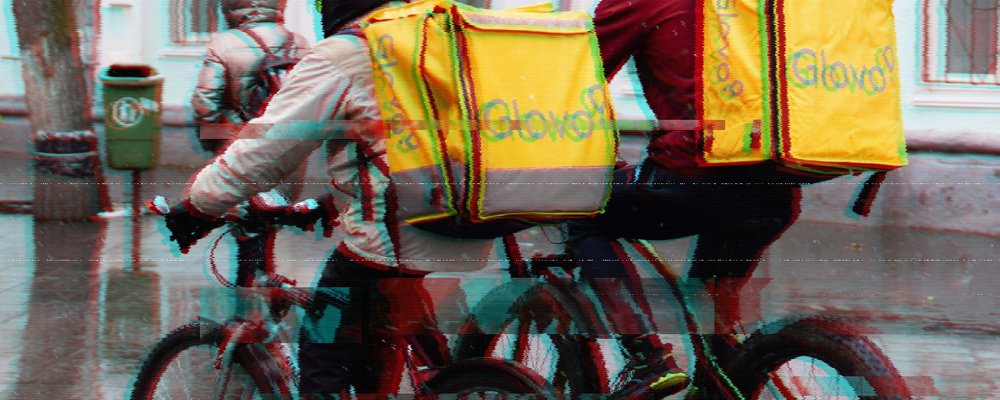
The SOS Food Bank in Warsaw is a non-governmental organization founded by Jacek Kuroń in the early 1990s. The bank’s goal is to obtain food and distribute it free of charge to those in need. It is part of the Federation of Polish Food Banks. For three years, SOS Food Bank has been collaborating with the Glovo platform. Together, they are implementing a project to deliver food to over 880 people monthly.
And now we have a problem: a much-needed social organization is collaborating with a company whose entire operations are based on ruthless labor exploitation. This is a fact confirmed by court judgments and fines, the total amount of which may exceed €1 billion (we have reported this numerous times).
We contacted Anna Wolska from the SOS Food Bank to ask for her comment on this situation and our concerns:
“Regarding ethical issues, I must be guided daily by the principle that we operate under the rule of law and trust the public institutions that enforce it. I cannot conduct investigations into every company operating in Poland (let alone those operating globally) and act like an investigator—and then like a court that must assess whether what I “Googled” is true, who was right, and so on. Our job is to save food and help people, and to trust that if someone is active in the market and wants to do good together with us, then it is legal.”
As if that weren’t enough, in just a few days, Glovo and Coca-Cola are launching a promotion: every order of this beverage on Platforma automatically provides the equivalent of one meal to a person in need, as part of their partnership with the SOS Food Bank. Unfortunately, we haven’t been able to find information on exactly how this is supposed to be done or how much the compensation is.
If you want to know why Glovo in Poland can violate workers’ rights with impunity, we invite you to read our report “What the State Knows About Our Work.” The premiere is this Thursday, November 27, 2025, at 6:00 PM, Zachęta National Gallery of Art, Warsaw (more here)