
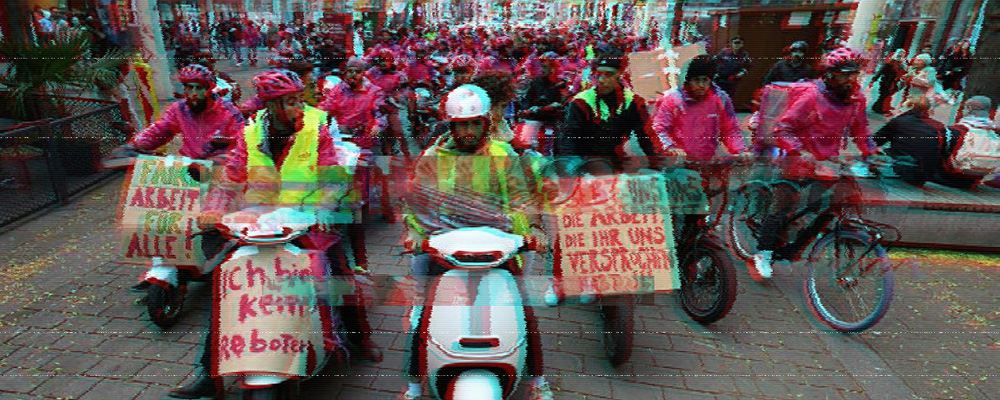
Today we present an excerpt from our conversation with Robert Walasinski, who worked as a supplier for the Foodora platform. He tells us how, by creating a Workers’ Council, they thwarted the platforms’ plans for a major international merger.
You can find the full interview in our report “What do you know about our work?” (here).
How long did you work at Foodora?
Until mid-2019. but the key events happened a bit earlier, when the work council won some specific rights. One of them was, that if a company – Delivery Hero in that case – planned big changes, they had to inform us and negotiate with us.
What changes were they?
Delivery Hero took a decision to reform into a so-called Societas Europea; a special form of a EU-based company, operating across different member states. In their case it meant combining HQs of Berlin and Amsterdam.
And you, as Foodora’s work council members, had to be involved in those negotiations?
Yes, exactly. It was even funny in a way: we, simple food delivery workers, suddenly became partners in negotiations among the management and financial executives in Berlin. They had to negotiate with us, because that’s what the EU regulations demanded. And we sat there thinking: “What’s going on? Is this really happening?”
Were you able to say “no” then? To block their decision to reform the company?
Yes, theoretically so. Of course, we were not alone: there were worker delegates from Germany, Norway, Italy and several other countries. But formally, we had a voice and we had to become involved in the negotiating process.
Did you have a real impact on the changes?
Yes. That was demanded by the EU regulations. If a company forms a structure conforming to Societas Europea, it has to involve worker delegates in the negotiations. This is a right applying in all EU member states that a company operates in.
What did the negotations look like?
We were first invited over to Berlin. They organized a meeting in a four-star hotel, with full board – it was looking as if they wanted to bribe us. We said it plain though: “we don’t know yet what you’re planning. First we’d like to have a training to understand what your plan is”.
What did the management think of it?
They were furious, because they had planned to have it over with in three days. And we reminded them, that we had the right to a half a year of negotiations. And so, the next meeting was for us to have a training. The hotels became worse and worse over time, but the talks continued.
And did you manage to win anything through the negotiations?
Yes. We won ourselves a place for worker delegates in the structure of the new company. That was something that the company did not want, but they had to accept in order for the process not to drag on.
So in practice, you gained an impact on the operation of the entire corporation?
Exactly. Even more: as they had to invite us to the talks and pay travel costs, we met workers there from other countries, like Germany, Norway, France or Italy. And that’s how our international network of platform workers came about.