
CONSTANT MANIPULATION
Yesterday in Poznań, we presented the new edition of our brochure “This Is What Exploitation Looks Like.” It’s a collection of our conversations with people working as suppliers for Platforms. One of them is Franek, who co-organized yesterday’s meeting (thank you!). Below is an excerpt from our conversation; you can find the full interview in the brochure available here.
Tell us a little about yourself: how did you end up working as a supplier for Platforms?
My name is Franek, I’m 28 years old. I’ve been working as a supplier for Platforms since 2020, and I started as a delivery driver earlier, in 2019. I started working as a courier during my studies to support myself. I chose delivery work because they were eager to hire students back then, and I’ve always loved cycling – for a while, cycling was my passion.
The first company I delivered for was PizzaPortal, which operates within the restaurant company Amrest. We delivered orders from Amrest restaurants – KFC, Burger King, and Pizza Hut. Initially, they offered a minimum-wage contract with all the necessary tools – a phone, bag, clothes, and a bike. Amrest sold PizzaPortal to the Glovo platform, and they immediately closed it down.
My first strictly platform-based courier job was for Wolt. I started as a student in 2020. Wolt was just entering the Polish market at that time, and the terms they offered were, compared to today, really good – a contract of mandate with a guaranteed hourly rate and bonuses. At that time, they paid us half the guaranteed hourly rate for each delivered order, meaning that from the third order completed within an hour, you were charged this amount as a bonus. Plus a backpack and clothes. I worked for them on and off for about two years. I quit when they started pushing us into partnerships and sole proprietorships.
Besides Wolt, have you worked on other platforms? Do you work by bike? Or perhaps a scooter or car? Do you run your own business or do you work through a Partner?
I’ve always worked by bike and still do. Since it’s been necessary, I’ve had a contract with a Partner. I’ve worked on many platforms: Wolt, Glovo, Uber Eats, Bolt, Stuart, SzamaExpres. I had a stint at the aforementioned PizzyPortal, as well as Pyszne.pl and the Norwegian Foodora.
How many days and hours do you work per week?
When couriering was my main source of income, I worked between 1/2 and 3/4 full-time. The longest I worked this way was about a year. However, since last winter, I’ve been riding very little because my back started giving out. This job isn’t healthy in the long run.
You mentioned that you worked in Norway. Tell me: how is working in Norway different from working in Poland? The pay is obvious, but there are also other issues: working conditions (especially in winter), respect for employee rights, how were you employed there? Are there fleet partners there?
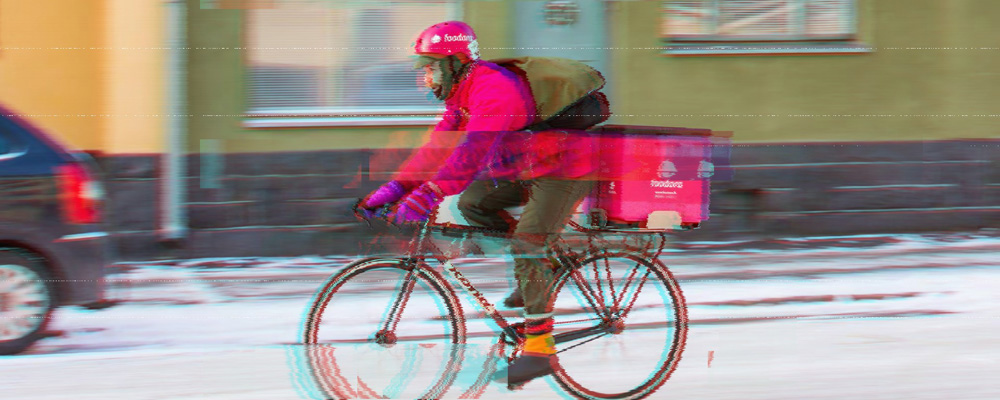
I worked in the summer, so I didn’t experience the harsh Scandinavian winters. Oslo, where I was stationed, is hilly, so people tend to use electric bikes there—either owned or rented. Foodora didn’t offer bikes to employees. There was a hub where you could potentially warm up or grab a bite to eat during your break. Service shifts were held there, so you could get your bike adjusted or have a minor problem fixed for free. Each employee received a backpack, helmet, phone case, and power bank. Everything had to be returned at the end of the contract. It was clear that the delivery staff was primarily migrants, while Norwegians worked in restaurants as waiters and served us food. I think this was mainly due to the differences in the symbolic status of these two professions. This was interesting to observe a few years ago, though it’s less surprising to me now that we’ve replicated the same division in Poland.
Regarding contracts, there were three options: direct employment through Foodora, freelance employment (through Foodora or through your own business). And employment through a partner. The first option was not available to people with a temporary work permit, like me. This option was offered to employees with longer experience, and these individuals could belong to a trade union. The second option, as a freelancer employed by Foodora, was the most popular form of employment. Employment through a partner, on the other hand, was marginal and primarily allowed for tax-deductible expenses, such as fuel. However, the partner market as we know it in Poland is practically nonexistent, as, as far as I know, there are only two companies offering this service.
I worked as a freelancer. Under this contract, I paid health insurance contributions and was insured, but I don’t know if I was entitled to paid sick leave. After the strikes in 2019, a minimum hourly wage system was introduced, along with additional bonuses based on the number of orders. However, this only applies to employees directly employed by Food. As a freelancer, I could choose between two types of settlement: The options were either a fixed hourly rate (around the minimum wage) or payment by order, without any guarantees.
Generally, there was a sense of two worlds within the platform – directly employed workers and freelancers. This division in the type of contract offered accumulated many other divisions, primarily ethnic and cultural ones, and differences in status were visible. This was certainly a factor that could influence the direction of the union’s actions, as only those who were, in some sense, distinguished could belong.
But this is a theme that seems to recur quite often in the context of trade unions, and it’s certainly worth considering in our own backyard, where a very large number of platform workers are not Polish citizens.
And for you, was this work a necessity or a choice? Is there anything cool about it?
Was it a choice? I really enjoyed cycling (and still do, though not as much as I used to). It was incredibly enjoyable to be able to spend my days physically active. After a few weeks, I would enter a kind of trance, and work would feel like a workout. Plus, at that time, I appreciated being able to work alone, as I’m a shy person. If someone loves cycling, and cycling is something you can truly love – then this job itself seems like an incredible privilege. Getting paid to ride a bike. Can you imagine that?
And also:
DELIVERY UNITED T-shirts in our STORE >>>
#deliveryunited